
ONE PAGE. ZERO STRESS
PDF CHARTS FOR THE WORKING DRUMMER
SAVE TIME. PLAY MORE
Welcome to the ultimate resource for gigging and working drummers!
These one page drum charts are created by Ben Whyntie, a drummer with over 20 years of experience playing in real-world professional settings. He knows exactly what you need when the lights are low and the gig is about to start — and what you don't need.
Tired of scrolling through long, complicated, or incomplete charts on stage? Ben's charts are different. Every chart is a concise, one-page PDF that gives you all the essential information you need to nail the tune, every time. No fluff, just the fundamentals: structure, hits, pushes, and fills.
Created to be the ultimate stage partner, these charts are all about speed, clarity, and reliability. Get them now to save time on preparation and nail the song every time!
FEATURED CHARTS
STOP GUESSING. START PLAYING
Are you a professional or experienced drummer tired of writing last-minute notes on a napkin? Got a last minute dep gig and need to learn a lot of songs fast?
DRUMCHARTS.CO.UK is here for you and offers concise and professional drum charts designed specifically for the busy, working drummer.
Ben’s drumming career has seen him play over 600 functions gigs, multiple tours and 100s of studio sessions. All of this has required learning lots of songs quickly. To help with speed (and a bad memory) he developed a short-hand method of writing drum charts that would conveniently fit on one page and give him all the essential info needed to be able to play the song accurately every time.
Just a reminder, these charts are not full transcriptions. They contain the essential info you’ll need to play the song from start to finish all on one page. They are designed for drummers who:
Know the song and need a reliable map.
Has a foundational understanding of music notation.
Requires quick-reference reminders, not full note-for-note transcriptions.
Needs to nail the arrangement every single time.
Each chart is clearly laid out containing the following:
Song structure (intro, verse, bridge, chorus etc).
Length of each section.
What type of beat to play and on what cymbal (hi-hat, ride, disco, 4 to the floor etc).
Featured notation for specific stops, accents, fills etc.
Other info such as important dynamics, tempo changes, time signature changes.
To get you started, you can download Mr. Brightside for free!
ALL THE INFO YOU NEED ON ONE PAGE
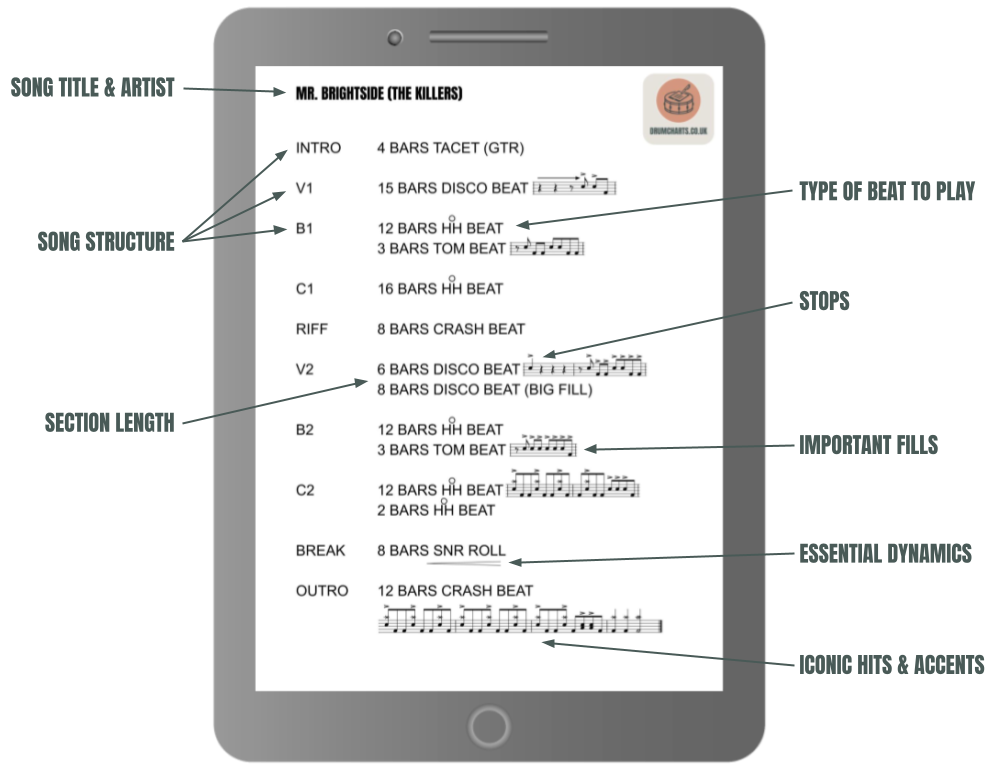
THE DETAIL EXPLAINED
SONG STRUCTURE:
The song structure is clearly labelled throughout the chart. Typical examples include…
V (verse)
B (bridge)
C (chorus)
M8 (middle 8)
PC (post-chorus)
SOLO
INTRO / OUTRO
RIFF (instrumental section with the main song riff)
INST (general instrumental section with no vocals)
BREAK (musical breakdown)
SECTION LENGTH:
The number of bars (measures) that each section contains and how long you should do something for. So ‘8 BARS HH BEAT’ means play an appropriate hi-hat beat for 8 bars. If the songs is in 4/4 then play 8 bars of 4/4.
TYPES OF BEAT:
Rather than score out the whole beat for the entire section and take up loads of space on the page this is a simple way of describing what the drums should be doing. This is where an understanding of the song comes in handy so that you can play an appropriate beat/groove to suit the song. Typical examples include…
HH BEAT (play either closed, half open, or fully open as marked)
RIDE BEAT (timekeeping hand on the ride cymbal)
CRASH BEAT (timekeeping hand on the crash cymbal)
DISCO BEAT (usually 16ths on the hi-hat and kick 4 to the floor)
HH & RIM BEAT (timekeeping hand on the hi-hat with cross stick on the snare)
HH & KICK (just hi-hat and kick, no snare)
4TTF (beat with kick on every beat)
HH ONLY (usually in dropdown sections to keep time)
SYNCH BEAT (indicated that the groove has some syncopation on the kick and/or snare)
TACET (don’t play - it’s latin for “is silent”)
ESSENTIAL DYNAMICS:
Drums are loud and playing them loud is fun but there are times when we need to increase or lower the dynamics. To keep this simple there is occasionally a crescendo (get louder) or a decrescendo (get quieter) when it really matters. These are marked on the charts as standard music notation ‘hairpins’.
STOPS / IMPORTANT FILLS / ICONIC HITS & ACCENTS:
As drummers we’re probably the band member that can get away the being the most “inaccurate” when it comes to playing the general beats of a song. Does anyone care if the kick and snare pattern aren’t an exact match in ‘Summer Of ‘69’? Not really. However there are certain parts of a song that make it iconic for both the whole band and the drums. These can be anything from playing a specific groove to stops, accents, hits and fills. Getting these right can make the difference between a good drummer and a great drummer.
To provide the most accuracy and signify their importance on the chart these parts have been written out using standard drum/music notation.
If you see an arrow this dictates that you should continue playing the beat until the notated drum fill.
All this information and more can be found in our quick reference guide which you can download by clicking the button below.